

Einfach & schnell zur perfekten Bewerbung | ⏱️ Sofort-Download | 💼 Kein Abo – immer wieder nutzbar | 📝 100 % bearbeitbar in Word, Google Docs, Canva & Pages
80+ reviews from satisfied buyers
✔ Verified Purchase
“Very good product and friendly contact with the seller.”
— Katja Techet, January 14, 2025
✔ Verified Purchase
“Very nice template! Everything is wonderful!”
— Laura, November 21, 2024
✔ Verified Purchase
“Very well designed, easy to use.”
— juliamurr, December 10, 2024
€4
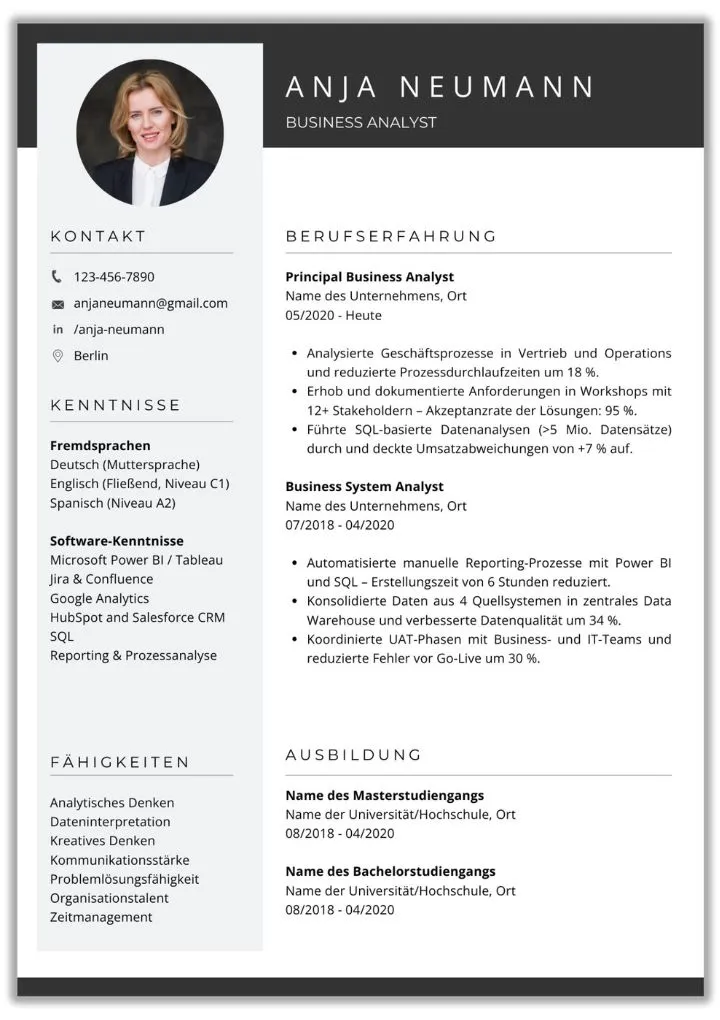
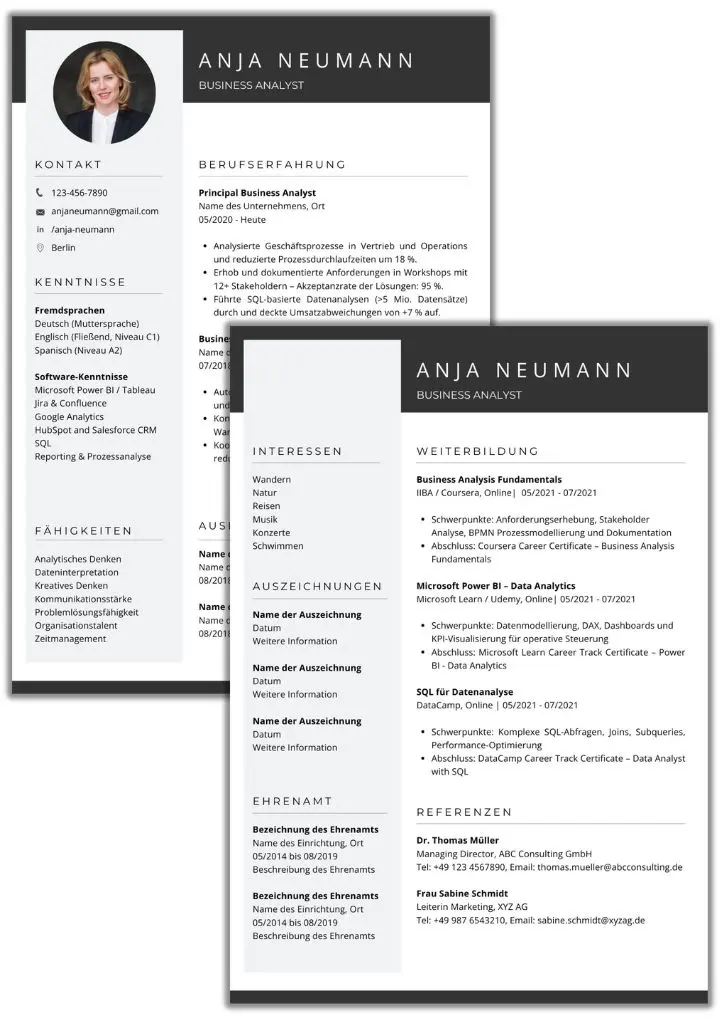
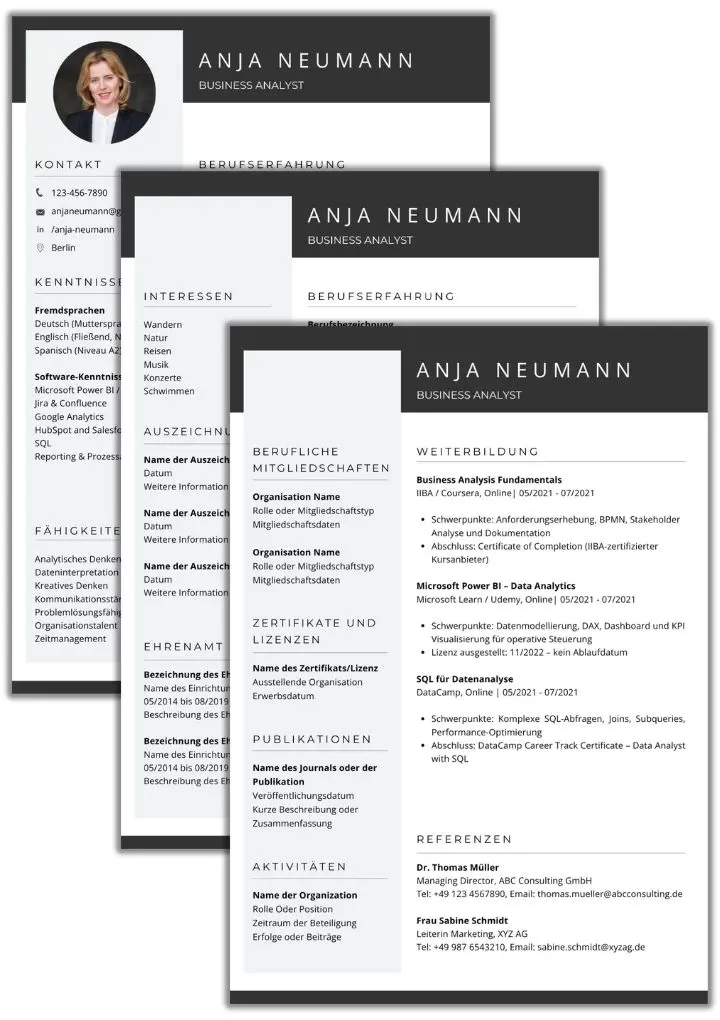
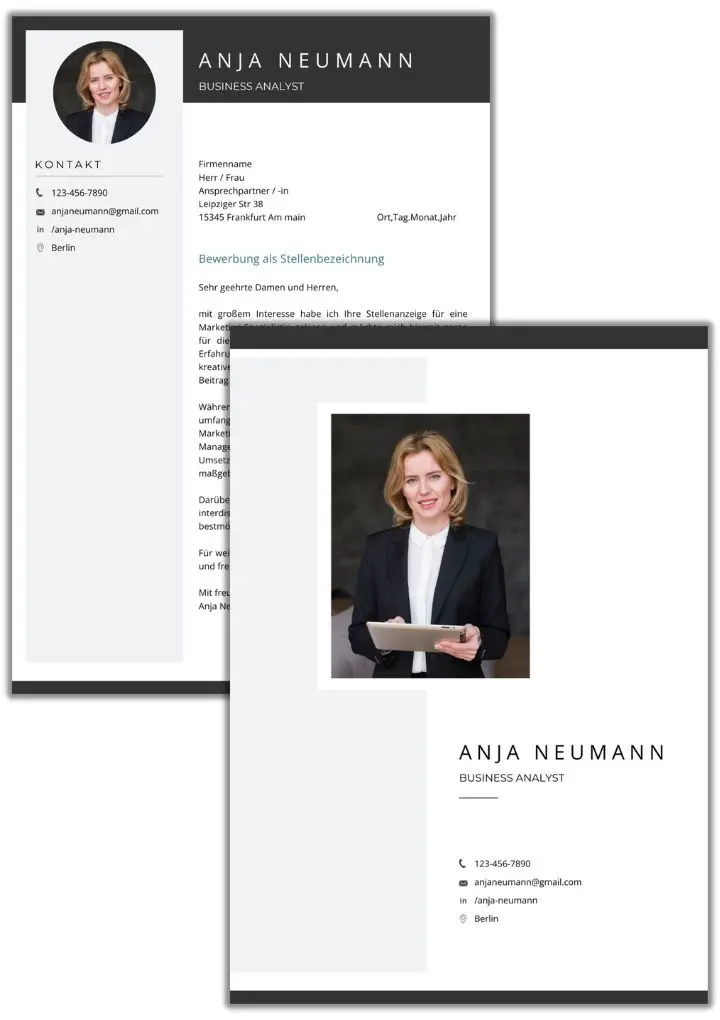
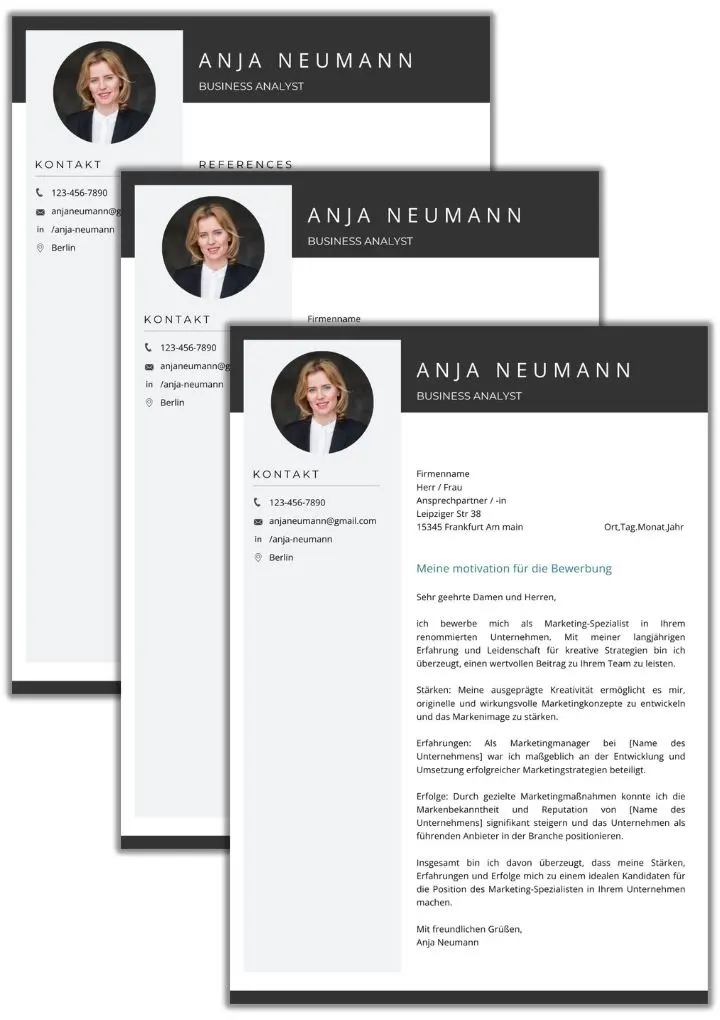
This Business Analyst CV template provides you with a professional, tabular layout in a modern design — instantly editable in Word and exportable as a PDF. Designed for applicants who want to present their analytical strengths, skills in tools like Excel or SQL, and project experience in a clearly structured way.

A Business Analyst CV template is a fully structured, professionally designed application document specifically tailored to the requirements of Business Analyst positions in Germany. Unlike a general template, it takes into account the specific expectations of HR managers and Applicant Tracking Systems (ATS): It systematically highlights data analysis, requirements analysis, KPIs, data modeling, and relevant tools such as SQL, Power BI, Excel, or Tableau – precisely where recruiters look first.
The difference to a standard template lies in the details. A business analyst moves daily between technical teams, management, and specialist departments. Their resume must reflect this: analytical hard skills on the one hand, and strong soft skills such as communication and teamwork on the other. This template provides the right structure – and you fill it with your own content.
A business analyst is applying for a job in an environment where HR professionals review dozens of resumes daily. Studies show that recruiters need an average of 5–7 seconds to decide whether to read a resume further. In that time, your profile as a business analyst must be immediately recognizable.
📊 Over 4,000 Business Analyst positions are currently advertised in Germany – a clear signal of the high demand for data-driven roles.
A specialized business analyst template reduces decision-making effort: structure, skill sections and results presentation are already prepared – you only add your content.
Developed based on typical recruiter reading behavior and business analyst application requirements in the German market.
Business analysts are the interface between business departments and IT. Employers therefore expect more than just tool knowledge – they are looking for candidates who can structure complex requirements, coordinate stakeholders, and achieve measurable improvements.
💡 Recruiters see many resumes every day. What stands out is not the template itself, but how clearly your impact, responsibility, and results are evident.
Many applicants use the same version of their resume for every application. Successful candidates do things differently.
A good template is the starting point – a truly strong resume is created through targeted customization. Recruiters immediately notice whether an applicant understands what the company needs. Three steps will help:
💡 Tip: Spend no more than 30 minutes per application on customizing your application. Focus on the job title, summary, and the top 3 bullet points of your most recent position.
This template is the right choice if you are applying for a position as a Business Analyst, Business Intelligence Analyst, Senior Business Analyst, or Junior Business Analyst. It is suitable for applicants who use tools such as SAP, SQL, Power BI, Tableau, Excel, or Python and want to professionally showcase their data analysis skills.
Especially suitable for:
Internships & Study Experience
Applicants with internship experience and relevant studies who are creating their first professional CV as a Business Analyst.
Business analysts work in virtually every industry. This template is therefore universally applicable – from retail to pharmaceuticals, from logistics to financial services. It covers industry-specific requirements because it offers enough structure to flexibly incorporate relevant content.
Suitable for:
A well-structured business analyst resume follows a clear logic: recruiters don’t read linearly – they scan. Each section therefore has its own function and is evaluated differently. Here’s how to execute each part correctly.
Many applicants list their skills at the end of their resume – thus wasting their impact. A well-designed skills architecture improves readability for recruiters and simultaneously enhances recognition rates by ATS systems.
💡 Rule of thumb: List hard skills, demonstrate soft skills. Don’t just write „strong communicator,“ but prove it, for example, through presentations to stakeholders or facilitated workshops.
Your name is your personal brand. It’s prominently displayed at the top, large and clear. In addition, include: a currently reachable phone number, a professional email address (firstname.lastname@provider.de), your city of residence (city is sufficient for German job postings), and a link to your LinkedIn profile. That’s it. Further personal information is optional and is often omitted these days.
Including the job title directly below your name – for example, „Business Analyst“ or „Senior Business Intelligence Analyst“ – is an underrated step. It immediately tells the recruiter what you do. Use the exact title from the job posting for this.
This section is located directly below your contact details and is the first thing recruiters read. Many applicants underestimate it, yet it often determines whether a recruiter continues reading or not.
Formula for a strong business analyst profile:
[Level of experience] + [Specialization] + [1-2 measurable strengths] + [what you offer the company]
Good example (senior):
Business analyst with 6 years of experience in data analysis, requirements analysis, and process optimization for international companies in IT and supply chain. Specializing in Power BI dashboard development and SQL-based reporting automation. Brings cross-functional teams together on a common data foundation and provides management with the information they need for informed decision-making.
Good example (junior / career starter):
Entry-level professional with a degree in economics and internship experience in data analysis and process documentation. Proficient in Excel, SQL, and basic dashboard tools. Analytical thinker, strong communicator, and motivated to measurably improve business processes.
Good example (career changer):
Former project manager with four years of experience in cross-functional teams, transitioning to business analysis. Familiar with requirements analysis, stakeholder communication, and data modeling from daily project work. Certified Scrum Master (CSM) with in-depth knowledge of SQL and data visualization.
Three to five sentences. No personal pronouns. No vague phrases like „team player and resilient“ – instead, concrete skills and a clear connection to the advertised position.
This section is the heart of your business analyst resume. List your experiences in reverse chronological order (most recent position first). For each position, include: job title, company, dates, and 3-5 bullet points outlining your responsibilities and achievements.
The most common mistake: describing tasks instead of showing results.
| Weak | Strong |
|---|---|
| Data analysis performed | SQL-based analysis of 2 million data records – error rate in reporting reduced by 35% |
| Dashboard created | Automated Power BI dashboard for 6 departments – replaces manual reporting, saves 8 hours/week |
| Requirements analysis performed | Requirements analysis for SAP ERP implementation with 150 stakeholders – project schedule undershot by 3 weeks. |
Start each bullet point with an action verb: analyze, implement, develop, optimize, coordinate, reduce. And: numbers are your best friends. Percentages, time savings, cost reductions, user numbers – anything you could measure belongs in there.
The following examples show typical business analyst resumes for different experience levels and specializations. They will help you better understand the wording, structure, and impact.
This example shows a senior business analyst with a consulting background and experience in transformation projects.
Email: max.mustermann@gmail.com
Phone: +49 152 345 6789
Berlin, Germany
LinkedIn: linkedin.com/in/max-mustermann
Senior Business Analyst with 7 years of experience in data-driven transformation projects in telecommunications and industry. Focus on SAP transformation, KPI-based management, and BI-supported decision-making. Proven in moderating complex stakeholder landscapes and translating business requirements into scalable data solutions.
Siemens AG, Berlin — Senior Business Analyst
03/2021 – Today
Deutsche Telekom AG, Bonn — Business Analyst
06/2018 – 02/2021
Accenture GmbH, Frankfurt — Junior Business Analyst
09/2016 – 05/2018
M.Sc. Business Analytics – TU Berlin (2016–2018)
B.Sc. Computer Science / Industrial Engineering – FU Berlin (2013–2016)
PMI PBA | Tableau Desktop Specialist | Machine Learning (Coursera, Stanford)
Tools: SQL, Power BI, Tableau, SAP/SAP BW, Python, MS Excel, AWS, SharePoint
Languages: German (native speaker), English (C1)
Soft Skills: Teamwork, problem-solving, analytical thinking, time management
In addition to technical expertise and project experience, certifications can be a crucial differentiating factor. They demonstrate initiative, methodological knowledge, and continuous professional development – regardless of the current employer.
Especially in the business analyst field, certifications signal a structured approach, an understanding of established methods, and a willingness to develop professionally.
| certificate | focus | relevance |
|---|---|---|
| CBAP (IIBA) | Internationally recognized BA certificate | High |
| PMI-PBA | Business Analysis in a Project Environment | High |
| Certified Scrum Master (CSM) | Agile methodology | Medium |
| IREB CPRE | Requirements management | Medium |
| Microsoft Power BI | Data visualization & reporting | Medium |
| AWS Cloud Practitioner | Cloud Basics | Low-Medium |
| ITIL Foundation | IT Service Management | Industry-dependent |
Important: Only list certificates that you actually hold or are currently completing. If you are still preparing for a certificate, you can clearly state this along with a planned completion date.
💡 Tip: You can demonstrate competence even without a certificate – for example, through completed online courses, project work, or documented learning achievements. Certificates complement experience, but do not replace it.
Because a standard template won’t make you stand out in a field of applicants full of business analysts. This template gives your data analysis skills, KPI achievements, and knowledge of SQL, Power BI, Tableau, or SAP the stage they deserve. Professional layout, fully editable, ready to use immediately – and ATS-optimized for the German job market.
Designed for business analysts who want to make results visible instead of just listing tasks.
Instant download after purchase. Buy once, use as often as you like.
A business analyst acts as the interface between business departments and IT. They analyze processes, identify weaknesses, and translate business requirements into actionable solutions for development teams. Typical tasks include stakeholder interviews, process modeling (BPMN, UML), requirements documentation, and solution testing. This role is in demand across various industries – from IT and finance to logistics and pharmaceuticals.
📊 On average, business analysts in Germany earn around €67,000 gross per year.
Munich, Frankfurt, and Stuttgart pay up to 15% above average. Certifications such as CBAP or PMI-PBA can significantly increase salary.
Beginners: 1 page. Experienced BAs: maximum 2 pages. More than that is rarely read in its entirety. Quality is more important than length – every line should offer concrete added value. Positions held more than 10 years ago do not need to be described in detail.
Yes. Most newcomers come from a university degree (business informatics, business administration, computer science) or from a career change in controlling, IT support, or project management. What counts: analytical internships, proficiency in tools like Excel, SQL, or Power BI, and the IIBA/ECBA certificate as initial proof of qualifications. Many companies specifically offer junior BA or trainee programs.
Tools: Excel, SQL, Power BI, JIRA, Confluence, Visio
Methods: BPMN, UML, Scrum, User Stories, Stakeholder Management
Soft skills: structured communication, moderation skills, analytical thinking, German & English
Only list skills you truly master – recruiters will specifically ask about them in the interview.
Recruiters almost always research candidates online. If your LinkedIn profile shows a different focus than your resume, it creates uncertainty. Consistency signals professionalism and strengthens your personal brand as a business analyst.
💡 Quick Check: Open your resume and LinkedIn profile side by side. Do the job titles, time periods, and focus match? If not, invest 20 minutes – it makes a bigger impact than any design change.